Relax Gaming in 2026: Money Train, Dream Drop and the Studio’s Key Mechanics
Relax Gaming has built its identity around games that are easy to understand at first glance but capable of changing sharply once their main features begin to interact. In 2026, that approach is visible in three areas in particular: the continuing Money Train series, the expanding Dream Drop jackpot network and a wider set of mechanics built around respins, tumbles, clusters, persistent symbols and progression. The company is not relying on one formula. Money Train 5 is scheduled for 24 September 2026, Dream Drop now appears across more than 50 titles from several studios, and releases such as Treasure Tumble, Purrrminator Dream Drop, Money Plane and Nugget Ridge show how Relax keeps reworking familiar ideas rather than simply repeating older games. The important point for players is that these mechanics affect pace, volatility and bonus behaviour in different ways, so the name of a feature alone never tells the whole story.
How Money Train Became Relax Gaming’s Defining Series
The first Money Train arrived in 2019 with a relatively straightforward structure: a 5×4 reel set, 40 fixed paylines and a maximum win of up to 20,000 times the stake. Its lasting importance came from the Money Cart bonus. The original version used a respin-based feature in which special symbols could keep the round moving and build value over time. That format gave the game a clear rhythm. A player did not need to memorise a long set of rules before understanding the central idea: useful symbols extended the feature, while multipliers and special effects could turn a modest round into a much stronger one. Relax later described the game as one of its best-performing early releases, and the basic bonus structure became the foundation for the sequels rather than a mechanic that was discarded after one title.
Money Train 2, released in 2020, expanded that foundation without removing its recognisable core. The maximum win rose to 50,000x, while characters such as the Collector, Payer, Sniper and Necromancer gave special symbols distinct jobs during the bonus. Some collected values, some increased other symbols and some could revive effects that had already disappeared. Money Train 3 pushed the stated maximum to 100,000x and added more persistent feature symbols, including the Shapeshifter and Absorber. Money Train 4 changed the structure more aggressively: Relax moved to a 6×6 layout with Scatter Pays, advertised more than 20 features and increased the maximum win to 150,000x. The progression across the first four games therefore involved more than raising headline numbers; each sequel added more ways for symbols to interact inside the main bonus.
That history also explains why the series is associated with high volatility and feature-led play. The biggest advertised win in any Money Train title is a theoretical ceiling, not an indication of what a normal session is likely to produce. The feature can remain quiet for several spins and then change rapidly when the right special symbols combine, which is part of the series’ design. Relax Gaming has repeatedly emphasised that the appeal comes from a simple central rule combined with outcomes that can become difficult to predict once several effects are active at the same time. This distinction matters in 2026 because the franchise has become more complex, but the core idea remains readable: keep the bonus alive, add or improve useful symbols and allow their interactions to build the round.
What Money Train 5 Changes in 2026
Money Train 5 is the most important current update to the series, but its status needs to be stated accurately. As of 4 September 2026, the game has been announced and shown to the industry, but its official release is scheduled for 24 September 2026. Relax originally presented Money Train 4 as the final instalment, then revived the series after its development teams found a progression idea they believed justified another sequel. In interviews published in August and September, the company said the new game keeps familiar characters and the broad Money Train identity while adding a mechanic built around movement and progression. Leah Neutel, Head of the Malmö studio, also confirmed that moving reels and changing environments are intended to make the player feel that the bonus is travelling through distinct stages rather than remaining on one static screen.
The fifth game also breaks the old pattern of simply increasing the maximum win with every sequel. Relax has confirmed two play settings: Standard Mode, with a maximum win of 50,000x and lower volatility, and Ultra Mode, with a maximum of 100,000x and higher volatility. Both ceilings are below Money Train 4’s 150,000x figure. The studio’s stated aim is to make the journey through the bonus less predictable rather than use a larger headline maximum as the main selling point. New characters include the Pyromancer and Ticket Master, both tied to the progression system, while the returning cast preserves the visual and mechanical link with previous entries. This is a useful example of how Relax Gaming is handling an established series in 2026: familiar features remain, but the structure around them can change substantially.
The Money Train name has also moved beyond the main slot sequence. Money Plane, released on 30 July 2026, is an arcade-style game set in the same wider universe. It offers five volatility levels, each connected to a different maximum win, and uses achievement-based awards rather than copying the Money Cart bonus directly. The release shows that Relax is treating Money Train as a recognisable game property rather than a single fixed reel format. That does not mean every related title will suit the same player. A high-volatility Money Train slot, an Ultra setting and an arcade-style Money Plane session can have very different pacing and risk. Looking at the actual rules, volatility description and feature structure of each title is therefore more useful than assuming that the franchise name guarantees one specific type of play.
Dream Drop in 2026: A Jackpot System Built for Different Games
Dream Drop began in May 2022, with Temple Tumble 2 Dream Drop becoming the first Relax title to use the new progressive jackpot feature. Early versions were described as a five-tier system, but the product has since expanded. In its current 2026 form, Relax Gaming presents Dream Drop as a six-jackpot network. Recent releases use the names Rapid, Midi, Maxi, Daily, Major and Mega. The key difference from a conventional slot sequel is that Dream Drop is not tied to one theme or one base-game structure. It is a jackpot layer that can be attached to games with very different reel layouts and bonus systems. This is why the Dream Drop label now appears on titles ranging from Tumble games and conventional line slots to releases with more unusual connected-symbol or side-bet mechanics.
The way a player reaches the jackpot is not identical in every Dream Drop game. Bill & Coin 2 Dream Drop, released in January 2026, can trigger a separate Jackpot Spin before the normal spin; landing the required Dream Drop symbols then leads to the jackpot bonus. Wild Chapo 2 Dream Drop uses a different presentation built around two jackpot wheels, while Cod of Thunder Dream Drop was designed to bring jackpot outcomes closer to its main game. This flexibility is one of the system’s most important characteristics. Relax can keep the same network prizes while adapting the entry sequence to the pace and visual identity of a particular title. For players, this means that knowing Dream Drop from one game does not remove the need to read the rules of another Dream Drop release.
The network has continued to grow quickly in 2026. By June, Relax said the Dream Drop range contained more than 50 jackpot titles across six studios. On 12 August 2026, the company reported its 32nd MEGA Jackpot winner since launch and the seventh MEGA win of 2026. That particular prize was €1,775,531.98, while other 2026 MEGA awards were also close to the €2 million level used in Relax’s current product messaging. These figures show the scale and activity of the shared jackpot network, but they should not be read as evidence that any individual player is likely to win a top prize. Progressive jackpot outcomes remain random, and past winners do not make a future jackpot more predictable. The relevant information for an individual game remains its own rules, stake range, volatility and published return information.
How Dream Drop Combines Frequency with Varied Core Mechanics
The current Dream Drop structure is designed around different prize frequencies rather than six identical jackpot pools. Relax describes the 2026 product as having six progressive jackpots, including two “must drop” levels and three daily jackpots, alongside the larger network prizes. In practical terms, the smaller and time-sensitive levels are intended to create more frequent jackpot events, while the upper tiers provide the much larger awards associated with the Dream Drop name. This is also why the product can produce many jackpot winners without the MEGA prize being awarded on every game or every day. The jackpot element runs across a large network of titles and operators, so an individual session is only a tiny part of the overall activity contributing to those prize pools.
Several 2026 releases show how far Relax is willing to vary the game underneath Dream Drop. Purrrminator Dream Drop uses a Reverse Avalanche feature in which strong connected wins can remain on the grid while the next sequence develops. World Class Kick Off Dream Drop combines six progressive jackpots with a Bet Slip feature inspired by sports betting, allowing side bets on specific symbols. Bill & Coin 2 Dream Drop keeps the recognisable characters and core style of its parent game but adds a separate jackpot entry spin. These are not cosmetic differences. They change what the player watches for during the base game and how the jackpot sits alongside the main feature. Dream Drop therefore works less like a single repeated slot template and more like a common jackpot framework attached to several distinct game designs.
That variety makes game information especially important. A Dream Drop logo tells a player that a title is connected to the shared jackpot system, but it does not tell them the volatility of the underlying slot, the exact route into its bonus or the return configuration available in a particular market. It also does not turn the jackpot into a strategic problem that can be solved by timing bets after previous wins. Each spin remains a random event under the game’s rules. For a practical comparison, players should focus on the size of the permitted stakes, the pace of the base game, how often the main feature can appear, if optional feature access is available locally and what the in-game information states about RTP and jackpot rules. Those details are more meaningful than the size of a recent winner’s prize.
Beyond the Flagships: Tumbles, Clusters and Progression Mechanics
Relax Gaming’s wider catalogue shows that the company does not depend only on Money Train-style respins. Tumble and cluster games have become another long-running part of its own-game output. In a tumble format, winning symbols are removed and new symbols can fall into the empty positions, allowing one paid spin to continue through several consecutive evaluations. Cluster games replace fixed paylines with groups of matching symbols, often on larger grids. Cluster Tumble, for example, uses an 8×8 grid, blocker tiles and power-up effects, while the Tumble series has repeatedly combined cascading wins with multipliers, wilds and free-spin features. The appeal is easy to understand without studying a complicated paytable: one win can alter the grid and create the conditions for another.
Treasure Tumble, released in March 2026, is a good example of how Relax is updating that formula. The game uses an 8×8 cluster-pays grid and combines tumbles with blockers, Compass Wilds, multipliers and bonus modes. Its headline Supercharge concept gives access to several upgraded spin options, including versions designed to increase bonus frequency or push the game towards higher-multiplier play. The maximum win is stated at 10,000x, considerably below the largest Money Train ceilings, which underlines an important point: innovation for Relax is not always tied to making the top possible payout larger. In this case, the emphasis is on giving the same underlying grid several different routes into stronger features and allowing a player to choose between different levels of intensity where local rules permit those options.
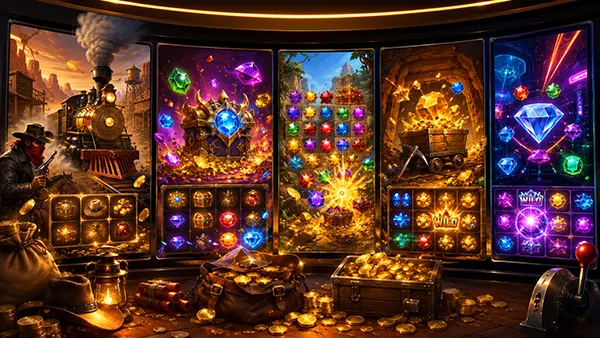
Newer releases also show a return to simpler, more accessible structures when that suits the concept. Nugget Ridge, released on 3 September 2026, uses familiar mining imagery but builds its action around TNT detonators that expand into Wilds, a re-spin sequence that can turn Bonus symbols into Sticky Wilds and free spins in which collected symbols later become multiplier Wilds. Relax specifically positioned the title as a more accessible-volatility game for a broad recreational audience. That matters because the studio is often associated with very high-volatility releases. Its 2026 catalogue includes both complex feature-heavy games and titles designed around fewer, clearer interactions. The common thread is not maximum complexity; it is the attempt to give each special symbol a visible purpose so the player can understand why the screen has changed.
Why Clarity, Market Rules and Player Choice Shape Relax Games
One of the less obvious influences on Relax Gaming’s mechanics is regulation. Feature-buy options are not available in every jurisdiction, and the company has created Money Cart versions for markets where direct bonus buying is restricted. In an August 2026 interview, Relax explained that Bonus Reels were developed to give UK players a compliant route to feature-led play without simply renaming a prohibited Bonus Buy. The company now plans Money Train and Money Cart experiences together so that the core idea remains recognisable while the access method fits local requirements. This is a useful reminder that two games with closely related themes can have different feature menus depending on where they are offered. Players should therefore rely on the version shown by their licensed operator rather than rules copied from another country.
Clarity is the other recurring design principle. Relax’s own explanation of Money Train’s success centres on a simple rule: the bonus starts with a limited number of respins, and useful new symbols can reset that count and keep the round alive. Complexity arrives through the interaction between characters, not through an obscure initial objective. The same principle can be seen in tumbles, where a win clears space for another symbol drop, and in Nugget Ridge, where detonators, sticky wilds and collected symbols have visible jobs. Even Money Train 5’s more ambitious progression system is being built around movement through stages that the player can see. This does not make the mathematics simple, but it makes the immediate cause and effect easier to follow, which is particularly important in games with several overlapping features.
Taken together, Relax Gaming’s 2026 releases show a studio trying to balance recognisable ideas with controlled changes. Money Train 5 keeps the franchise’s characters and bonus-first identity but introduces progression, moving scenery and a choice between Standard and Ultra risk levels. Dream Drop keeps one shared jackpot network while allowing each attached title to handle jackpot entry differently. Tumble and cluster games continue to use cascading grids, but newer releases add features such as Supercharge options, Reverse Avalanche behaviour or more focused wild transformations. None of these mechanics changes the basic reality that slot outcomes are random and that high maximum wins are theoretical possibilities rather than typical results. For players comparing Relax titles, the most useful questions remain simple: how volatile is the game, what keeps its main feature active, which symbols can change the round, and which version of the rules applies in the local market?